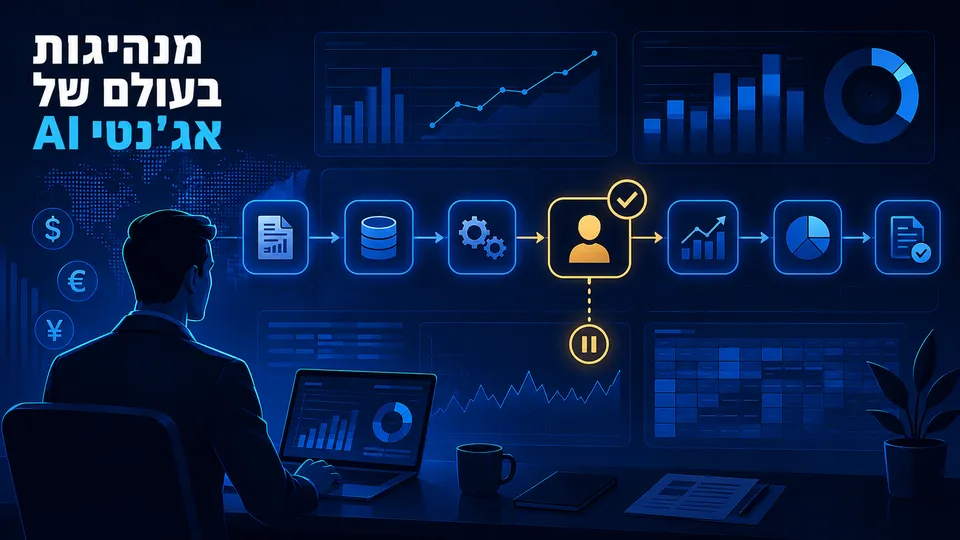
Agentic AI is more than a chat window returning an answer. It is a system that can receive a goal, plan several steps, use defined information and tools, and perform a sequence of tasks semi-autonomously. In finance, this might be an agent that monitors files on a schedule, checks whether all information has arrived, runs a set of checks, prepares a draft report and submits it for approval.
For managers, this does not mean replacing professional responsibility. On the contrary: the more steps a tool can perform, the more precisely permissions, stopping points, quality checks and the person responsible for the outcome must be defined.
What does agentic AI mean for finance?
In conventional AI use, a finance professional uploads a file, writes an instruction and receives an answer. They trigger each step and decide what comes next. In an agentic process, the user defines a broader goal and the system progresses through several actions using tools and connections approved in advance.
For example, an agent preparing a monthly variance report could:
- Check at the scheduled time whether budget and actual files are available.
- Verify that files are current and columns match the template.
- Identify unmapped cost centers or accounts.
- Calculate variances according to defined rules.
- Prepare an exceptions list and draft explanation.
- Stop and request a finance professional's review.
- After approval, prepare a version for distribution or a management presentation.
The difference is significant: managing a workflow, beyond merely generating text or a formula. Actual capability still depends on licensing, connections, permissions, data quality and security policy.
Why does this need a management decision now?
In an article published by HBS Working Knowledge in February 2026, Professor Tsedal Neeley and Ritcha Ranjan describe a shift from isolated AI use to systems able to plan and execute more complex processes. The article references McKinsey's 2025 global state of AI survey.
Read the figures carefully: 39% of respondents said their organization had begun experimenting with AI agents. Another 23% reported scaling an agentic system in at least one business function. That means 62% were at least experimenting, but scaling remained limited: in any individual business function, no more than 10% reported scaling agent use.
These are neither AI Finance figures nor a forecast for the Israeli market. They do indicate a stage where many organizations are experimenting while working methods remain unsettled. This is an opportunity to build controlled experience with narrow processes.
A brief quotation captures management's responsibility: “The human-in-the-loop moment will be critical” — Ritcha Ranjan, rendered from the Hebrew article's free translation of HBS Working Knowledge.
The loop: planning, execution and learning
HBS suggests thinking of agent work as a three-part loop. Finance teams can translate it as follows:
1. Planning: define the process before choosing a tool
First define what the agent should achieve, which information it needs and where it must stop:
- What event triggers the process.
- Which sources are permitted and who owns their validity.
- Which control totals must match.
- Which exceptions require stopping and approval.
- What the agent may read, create or change, and who approves output.
A process that cannot be explained on one page is probably too broad for a first pilot. Instead of asking an agent to handle the entire month-end close, start with checking a reconciliation file for completeness or preparing a draft status report.
2. Execution: run with human controls
Execution is not the stage where the manager disappears. Initially it should be divided into clear checkpoints. For example:
- The agent may read files but not change the source.
- It may suggest mapping or draft a message but not approve or send it.
- It may calculate a variance but must show source rows.
- It must stop if a control total differs or a file is missing.
Increase autonomy only after the organization has sufficient test results for that specific process. Success in one process does not prove suitability for another.
3. Learning: improve the process, not just the prompt
After every run, review what worked, where intervention was needed and which exceptions were not covered. Feed these findings into the next version of instructions and checks. Track:
- The proportion of runs passing control totals.
- Genuine exceptions versus false alarms.
- User corrections and interventions.
- Input or permission changes that caused failure.
A pilot's aim is not to promise savings in advance, but to prove that the process is consistent, controllable and stoppable.
Pilot example: preparing a draft cash flow report
Suppose a finance team prepares a short weekly cash forecast using balances, expected payments, planned collections and commitments.
The agent receives read-only access to an approved folder containing consistently structured files. Initially it does not connect to a bank account or make payments. The workflow:
- Check that all files exist and are current, and that opening totals match.
- Consolidate receipts and payments by date and category.
- Flag rows without a date, amount or owner.
- Produce a base scenario, decision points and sources for key numbers.
- Stop for the finance manager's review.
Acceptance criteria:
- Every number in the report links to a source row.
- Source files remain unchanged and missing data is never guessed.
- Assumptions are identified separately from facts.
- A final version is created only after approval.
What is the finance manager's role?
Technology does not remove management's duty to decide who is responsible. The process owner defines valid output; IT defines connections and documentation; information security and privacy teams approve sources and uses; and the professional user checks the result. There must also be a route back to manual work, because a critical process cannot depend entirely on a provider, model or connection.
How do Agents, Skills and Copilot relate?
An Agent moves between steps and uses tools. A Skill is a package of instructions, examples and rules teaching the system how the organization performs a task. The agent can use a Skill to act consistently.
For a practical explanation of the differences and recurring process design, read Skills and AI agents in finance.
Copilot is the name of several products and capabilities in Microsoft's environment. In some configurations it can edit files, use organizational sources or support multistep processes, but availability depends on licensing and organizational settings. See Microsoft Copilot for finance teams and Excel for more.
Risks to manage
- Overly broad permissions: Grant only the access the process needs.
- Errors propagating through the chain: Validate input and keep source links.
- Irreversible actions: Sending, deleting, posting or paying require approval.
- Lack of traceability: Keep records of actions, versions and approvals.
- Sensitive information: Use only approved environments and sources.
- Product changes: Revalidate capabilities, licensing and connections.
How do you start responsibly?
Choose a narrow, recurring, low-risk task. Document decision points, start with synthetic or approved data, use read-only access wherever possible and add control totals. Expand scope or permissions only after several testing cycles and professional, technical and security approval.
The test is not whether an agent once produced an impressive report. It is whether the team can explain how it works, recognize errors, stop it and produce an auditable result.
Frequently asked questions
Can an AI agent perform a financial process without a human?
Technically, some tools can execute a sequence of actions. An organizational financial process needs defined human approval points, especially before a decision, data change, distribution or irreversible action.
Do we need to start with a complex agent?
No. A first process should be narrow, frequent and easy to check. Monitoring, completeness checking or drafting generally fits better than responsibility for an entire financial process.
Which tool should we choose?
The choice depends on the information environment, permissions, licensing and process. Define the task and controls first, then compare tools.
Sources and verification date
Information checked on August 7, 2026:
- HBS Working Knowledge — What Leadership Looks Like in an Agentic AI World, by Michael Blanding, featuring Tsedal Neeley, published February 11, 2026.
- McKinsey — The State of AI in 2025: Agents, Innovation, and Transformation, a survey published November 5, 2025. It included 1,993 respondents from 105 countries; the figures reflect respondent reports and are not a dedicated measure of the Israeli market.
Want to explore an agentic process in your finance team?
In process mapping or an organizational workshop, we select a focused task, define sources, permissions, controls and approval points, and test it before expanding use. Arrange a process-mapping conversation or explore a suitable workshop.